
By Ben Raabe, CEO — Licensed Contractor | 25+ Years Experience
Demolition projects in Kentucky, from a single family house to a commercial building, require the right permit before work begins. The permit process protects worker and public safety and confirms the contractor is properly insured. Below, Bella Contracting Services breaks down when a Kentucky demolition permit is required, what it costs, and how the process works in Lexington-Fayette, one of Kentucky’s most active demolition markets.
Kentucky Demolition Permit Requirement
Yes. In nearly every Kentucky city and county, you need a wrecking or demolition permit before tearing down a house or commercial building. Kentucky’s Uniform State Building Code (KRS 198B.060) sets a statewide framework but assigns permit enforcement to each local government, and it does not make single family residential permits mandatory unless the local jurisdiction has adopted an ordinance requiring them. In practice, nearly every Kentucky city and county with an active building department, including Lexington-Fayette Urban County Government and Louisville Metro, has done exactly that. Commercial and multi-family demolition fall outside that exemption, so a permit is required wherever a local building department has jurisdiction. The applicant must also confirm that every contractor on the job carries Kentucky workers’ compensation and unemployment insurance, a requirement written directly into KRS 198B.060(10).
Source: Kentucky Revised Statutes, KRS 198B.060.
What Is A Demolition Permit?
A demolition permit is the local building department’s written authorization to raze, wreck, or remove a structure. It confirms that the project has liability insurance in place, that any asbestos on site has been identified and addressed, and that surrounding utilities and neighboring properties are protected during the work. Kentucky’s local building departments will not issue a permit until the applicant has submitted a demolition plan and proof of insurance meeting the jurisdiction’s requirements. Skipping this step exposes the property owner and contractor to fines, stop work orders, and personal liability for any damage the demolition causes.
Types Of Demolition Permits In Kentucky
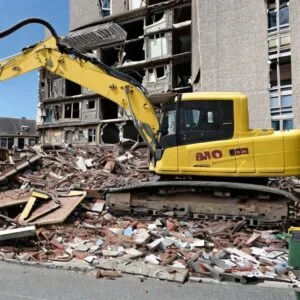
Kentucky does not use one statewide demolition permit category. Each local building department defines its own permit types and fee structure. Lexington-Fayette issues a single wrecking permit that applies to both residential and commercial structures. Louisville Metro instead classifies wrecking permits into three types based on building height and square footage, each with its own fee schedule. Because requirements differ by jurisdiction, the accurate first step on any Kentucky demolition project is confirming the specific permit type and process with the local building department, not assuming a single statewide standard applies.
Sources: Lexington-Fayette Urban County Code of Ordinances Sec. 5-29(6); Louisville Metro Construction Review permit fee schedule.
The Permit Application Process In Kentucky
The exact steps vary by city and county, but Lexington-Fayette’s process is a useful, well documented example of what a Kentucky demolition permit application typically involves. Property owners and contractors working specifically in Fayette County can find the complete process on Bella’s Lexington permit regulations guide. The checklist below reflects Lexington-Fayette Urban County Government’s current wrecking permit requirements.
The Steps to Applying for a Wrecking Permit
- Have a certificate of insurance. Coverage must include bodily injury per accident, property damage, and workers’ compensation, with the certificate naming Lexington-Fayette Urban County Government as holder and confirming coverage for the wrecking work.
- Get a grading permit. Contact LFUCG Engineering, 101 E. Vine St., 4th Floor, Lexington, KY 40507, (859) 258-3410, to determine the grading permit required for the project.
- Notify owners of surrounding properties. LFUCG provides a list of addresses within 50 feet of the property line; each must receive written notice of the planned demolition before work starts.
- Present an asbestos report. A private inspection agency must issue the report; a positive result requires proof of abatement before the permit is issued.
- Provide proof of contractor authorization. A signed letter from the property owner or authorized agent must give the contractor permission to perform the work.
- Obtain a sewer plug number. Contact LFUCG Water Quality, 125 Lisle Industrial Ave., Ste. 180, Lexington, KY 40511, (859) 425-2400.
- Submit a demolition plan. This is a step by step outline of how the structure will be brought down.
- File the complete application. Create an account and apply online at lexingtonky.gov/permits, then submit all documentation to LFUCG Building Inspection, 101 E. Vine St., 2nd Floor, Lexington, KY 40507, (859) 258-3770.
Source: Lexington-Fayette Urban County Government, Division of Building Inspection.
The Role Of Inspections In Demolition Permits
Inspections confirm that a demolition is proceeding according to the approved plan and that safety requirements are being met throughout the project, not just at the permit application stage. A building official may inspect site conditions, verify asbestos abatement, and confirm utility disconnection before work is allowed to proceed to the next phase. Failing an inspection typically pauses the project until the flagged issue is corrected, so having a contractor who prepares for each inspection checkpoint in advance keeps a Kentucky demolition project on schedule.
Common Issues With Demolition Permits In Kentucky
The most common cause of delay on a Kentucky demolition permit is incomplete paperwork, particularly a missing or expired asbestos report. Hazardous material handling is also a frequent issue: Kentucky and federal EPA rules require specific abatement and disposal procedures, and skipping them can halt a project and trigger separate environmental penalties. Some jurisdictions also enforce local noise ordinances that restrict demolition work to certain hours, which needs to be factored into the project schedule before work begins. An experienced Kentucky demolition contractor accounts for these requirements during the planning phase rather than discovering them mid project.
Frequently Asked Questions
Do You Need A Permit To Tear Down A House In Kentucky?
In most Kentucky cities and counties, yes. A wrecking or demolition permit is required before a house can be torn down. Kentucky’s Uniform State Building Code (KRS 198B.060) leaves the decision to require single family residential permits to each local government, and nearly every city or county with an active building department, including Lexington-Fayette and Louisville Metro, has adopted an ordinance requiring one. The permit applicant must also confirm the demolition contractor carries Kentucky workers’ compensation and unemployment insurance. Bella Contracting Services works on demolition projects across Kentucky. Get a free estimate to start the process.
What Is The Average Cost Of A Demolition Permit In Kentucky?
Demolition permit fees in Kentucky are set locally, so they vary by city and county rather than following one statewide rate. In Lexington-Fayette, the wrecking permit fee is two-tenths of one percent of the property’s assessed valuation, with a $100 minimum, per the Lexington-Fayette Urban County Code of Ordinances. Louisville Metro charges by structure size instead: a Type A wrecking permit is $75 for the first 1,000 square feet plus $10 for each additional 1,000. The permit fee covers only the application itself, not asbestos testing, utility disconnection, or debris hauling. For an exact figure covering the permit and the full scope of work, get a free estimate from Bella Contracting Services.
What Are The Legal Requirements For Obtaining A Demolition Permit In Kentucky?
Kentucky demolition permits are issued by the local building department with jurisdiction over the property, not by a single state office. The applicant must submit a demolition plan, proof of insurance, and, on most applications, an affidavit confirming that every contractor and subcontractor carries Kentucky workers’ compensation and unemployment insurance, as required under KRS 198B.060. Kentucky’s Department of Housing, Buildings and Construction licenses specific trades, including electricians, plumbers, and boiler contractors, but does not issue a general demolition contractor license. Local jurisdictions may add their own requirements, such as asbestos reports or neighbor notification. Get a free estimate from Bella Contracting Services to discuss the requirements for a specific project.
What Is The Time Frame For Obtaining A Demolition Permit In Kentucky?
Demolition permit timelines in Kentucky depend on the local building department and the complexity of the project, typically ranging from about one to four weeks. Straightforward residential applications with a complete asbestos report and insurance documentation move faster than commercial projects or properties flagged for historic review, which can add a 30 day hold in some jurisdictions. Missing paperwork is the most common cause of delay. Get a free estimate from Bella Contracting Services to see a project-specific timeline.
Are There Any Exemptions From Obtaining A Demolition Permit In Kentucky?
Kentucky’s Uniform State Building Code does not exempt single family residential demolition by default. It instead leaves the permit requirement to local ordinance, so a small number of rural jurisdictions without an adopted building inspection program may not require one, though most active jurisdictions do. Certain accessory structures below a local size threshold, such as a small shed, are sometimes exempt under specific local ordinances. These exemptions never remove other requirements, such as utility disconnection or asbestos handling under EPA and DHBC rules. Get a free estimate from Bella Contracting Services to confirm requirements for a specific property.
Conclusion
A Kentucky demolition permit is required for nearly every residential and commercial project in the state, though the exact process, fee, and timeline depend on the local building department with jurisdiction. Confirming the right permit type, insurance documentation, and any asbestos or utility requirements before work begins is what keeps a project on schedule and avoids fines or stop work orders. Bella Contracting Services works with property owners, general contractors, and facility managers on demolition projects across Kentucky, including Lexington-Fayette and beyond. Get a free estimate to start a Kentucky demolition project. For projects in Fayette County specifically, see Bella’s demolition services in Lexington.
Fully Insured | 100+ Verified Reviews Across All Locations | 24/7 Emergency Response