
By Ben Raabe, CEO | Licensed Contractor | 25+ Years Experience
Demolition in Detroit runs through three separate regulatory tracks that all have to clear before a crew can start work: a wrecking permit from the city’s Buildings, Safety Engineering and Environmental Department (BSEED), asbestos notification through the state’s Air Quality Division, and OSHA’s Subpart T demolition standard governing the work itself. Missing any one of the three stalls a project or draws a citation once it starts. Find an overview of all Bella demolition services here. This guide breaks down what each track actually requires, current as of 2026.

City Of Detroit Permitting Requirements
A wrecking permit from BSEED is required before a structure is demolished in Detroit, per Section 3303.8.1 of the Detroit City Building Code. Two narrow exceptions exist: one-story frame buildings or structures under 500 square feet, and demolition of 50 percent or less of a structure done incidental to a repair, alteration, or enlargement project. Outside those exceptions, the permit is required.
The wrecking work itself has to be carried out by the licensed wrecking contractor’s own employees, under that contractor’s direct supervision, and cannot be handed off to an independent contractor or subcontractor. The one alternative the code allows is a homestead property owner performing the work themselves without hiring a wrecking contractor at all. If the job involves blasting or explosives, Section 3303.8 requires a separate detailed plan covering the method and explosive type, plus sign-off from every utility and agency with equipment on or near the site.
BSEED’s Permits & Plan Review section (Coleman A. Young Municipal Center, 4th Floor, 2 Woodward Avenue) handles review and approval, through the same eLaps/ePlans portal used for building permits generally, the same department that issues the Detroit demolition permits Bella coordinates on every project.
Wrecking Contractor Licensing
Detroit licenses wrecking contractors separately from general building contractors, through the city’s Board of Examiners for Wrecking Contractors. Licensing requires a minimum of three years of wrecking supervisory experience at the foreman, superintendent, or supervisor level, with two of those years waivable for an applicant holding an architecture or civil engineering degree or registration. All licenses expire December 31 regardless of issue date.
The Board classifies contractors by structure type and height. Class A Unrestricted covers all buildings. Class A Restricted covers non-residential structures only. Class B Restricted covers non-residential wood-frame and solid-masonry structures up to three stories or 35 feet, excluding reinforced concrete or steel-frame buildings. Class B Unrestricted covers the same height and material limits but extends to residential buildings as well. Both classes require a $50,000 security bond, with higher workers’ compensation coverage required for Class A than Class B. Confirming a contractor’s class matches the structure being demolished is worth checking before work starts.
Bella Contracting Services holds a City of Detroit wrecking contractor license.
EGLE Environmental Regulations
The Michigan Department of Environmental Quality (MDEQ) was renamed the Michigan Department of Environment, Great Lakes, and Energy (EGLE) in 2019. Any current reference to “MDEQ” is out of date. EGLE’s Air Quality Division enforces the Asbestos NESHAP program statewide through the MiEnviro Portal: written notification is required at least 10 working days before regulated demolition or renovation activity.
The trigger differs by project type. All subject demolitions require notification regardless of whether asbestos is actually present. Renovations only require notification when the amount of regulated asbestos-containing material meets or exceeds the regulatory threshold. EGLE’s asbestos inspectors received more than 95,000 notifications and modifications to notifications in 2024. Missing or filing a late notification is a violation independent of the survey result, enforced jointly by EGLE and, for worker protection and contractor licensing, Michigan’s Department of Labor and Economic Opportunity.
OSHA Health And Safety Requirements
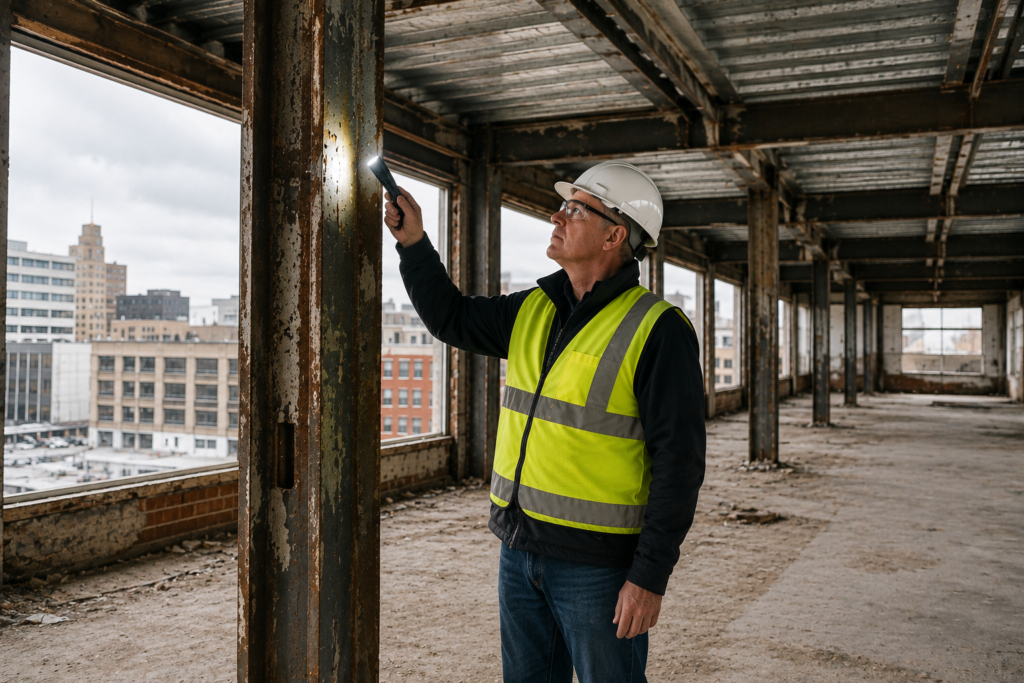
Every demolition site is governed by OSHA’s Subpart T standard, 29 CFR 1926.850 through 1926.860, layered on top of the general construction rules in Part 1926. Preparatory operations under 1926.850(a) account for up to three-fourths of the citations issued on demolition worksites, and the engineering survey requirement inside 1926.850(a)(1) alone accounts for more than half of those citations. Before any employee starts demolition work, a competent person has to survey the structure’s framing, floors, and walls to determine what will hold and what will not.
Beyond the engineering survey, Subpart T covers stairway and chute requirements (1926.851 through 1926.853), removal of walls and floors (1926.854 through 1926.856), and mechanical demolition and controlled implosion (1926.859 and 1926.860), all standards Bella’s commercial demolition crews work within on every Detroit project. Crews need documented training on the hazards specific to the structure being torn down, not generic construction safety training alone.themselves.
DWSD Water Clearance & Fire Hydrant Use Permit
Detroit adds one more procedural step most out-of-state contractors don’t expect: a Demolition Water Clearanceand Fire Hydrant Use Permit from the Detroit Water and Sewerage Department (DWSD), required before water service to the site can be disconnected. The contractor submits a water clearance packet, including a site plan, DWSD issues an invoice, and once payment is confirmed the water service is scheduled for disconnection. A separate Fire Hydrant Use Permit covers any hydrant water used on site during the demolition itself, with multiple permitting options available depending on how the water will be used. This runs on its own track, outside the BSEED wrecking permit process, and missing it is a common cause of last-minute demolition delays in Detroit.
Penalties For Non-Compliance
Non-compliance carries consequences at every level covered above. BSEED can deny, suspend, or revoke a wrecking permit or a wrecking contractor’s license over an incomplete application or a violation discovered mid-project. EGLE enforces Asbestos NESHAP violations with written warnings, administrative orders, and civil or criminal penalties. Most are resolved through a consent order requiring payment and future compliance, though repeat or knowing violations can escalate further. OSHA citations under Subpart T carry their own penalty structure tied to violation severity, and a citation on one project follows a contractor’s compliance history into every future bid.
None of these agencies operate independently of each other. A missed asbestos notification can stall a BSEED-issued permit, and an OSHA citation during active work can trigger a closer look from BSEED on the same site.
Frequently Asked Questions
What permit does a demolition project need in Detroit?
A wrecking permit from Detroit’s Buildings, Safety Engineering and Environmental Department (BSEED) is required before a structure is demolished, per Section 3303.8.1 of the Detroit City Building Code, with narrow exceptions for small frame structures and minor partial demolition. The application is submitted through BSEED’s eLaps/ePlans portal and reviewed by the department’s Permits & Plan Review section. Projects involving blasting or explosives require an additional detailed plan and sign-off from every utility and agency with equipment near the site. Bella Contracting Services holds a City of Detroit wrecking contractor license. GET A FREE ESTIMATE.
Who licenses wrecking contractors in Detroit?
Detroit’s Board of Examiners for Wrecking Contractors licenses wrecking contractors separately from general building contractors. Licensing requires a minimum of three years of wrecking supervisory experience, with all licenses expiring December 31 each year. Contractors are classified by structure type and height: Class B Restricted covers non-residential wood-frame and solid-masonry buildings up to three stories, Class B Unrestricted extends that to residential buildings, and Class A Restricted and Class A Unrestricted cover non-residential and all buildings respectively, with no height limit. Bella Contracting Services holds a City of Detroit wrecking contractor license.
Does a Detroit demolition project need water and hydrant clearance before work starts?
Yes. The Detroit Water and Sewerage Department (DWSD) requires a Demolition Water Clearance and Fire Hydrant Use Permit before water service to a demolition site can be disconnected, separate from the BSEED wrecking permit. The contractor submits a water clearance packet with a site plan, DWSD issues an invoice, and water service is scheduled for disconnection once payment is confirmed. This runs on its own timeline outside the standard permit process, and missing it is a common cause of last-minute demolition delays.
Does Michigan require advance notice before asbestos-related demolition?
Yes. Michigan’s Air Quality Division of EGLE requires written notification through the MiEnviro Portal at least 10 working days before regulated demolition or renovation activity. All subject demolitions require notification regardless of whether asbestos is present, while renovations only require it when regulated asbestos-containing material meets or exceeds the threshold. EGLE’s asbestos inspectors received more than 95,000 notifications and modifications to notifications in 2024. Missing or filing a late notification is a violation independent of the survey result, and can result in written warnings, administrative orders, and civil or criminal penalties.
What’s the most common OSHA violation on Detroit demolition sites?
Preparatory operations under OSHA’s 29 CFR 1926.850(a) account for up to three-fourths of citations issued on demolition sites nationally, and the engineering survey requirement inside 1926.850(a)(1) alone accounts for more than half of those. Before any employee begins demolition work, a competent person must survey the structure’s framing, floors, and walls to determine what will hold during teardown. This is a general OSHA compliance standard applying to every demolition contractor nationwide, not a Bella-specific practice.
Conclusion
Detroit’s demolition rules span three agencies that don’t share a single application: BSEED for the wrecking permit and contractor license, EGLE for asbestos notification, and DWSD for water and hydrant clearance, on top of OSHA’s Subpart T requirements once work begins. Bella Contracting Services holds a City of Detroit wrecking contractor license and works within all four tracks.