
By Ben Raabe, CEO — Licensed Contractor | 25+ Years Experience
New York, New Jersey, and Pennsylvania each adopted new data center rules in 2026, and two of them change how fast a data center site can move from demolition to construction. New York paused discretionary state environmental permits for data centers of 50 megawatts or more. Pennsylvania now requires projects over 25 megawatts to sign a binding Consent Order before the state will review their permits on a rolling basis. New Jersey took a different route, enacting a law the Governor’s office calls Data Center Fair Share, which governs how data centers pay for electricity, while local governments in Millville and Vineland used a citywide ban and stop-construction orders to control projects on the ground. For a contractor clearing an old industrial site, a closed retail building, or a retired power plant for a data center campus, these state and local shifts sit on top of federal asbestos and demolition rules that never went away. Here is what changed, state by state, and what to check before mobilizing.
New York’s Data Center Moratorium and the 50 MW Threshold
Governor Kathy Hochul signed Executive Order 62 on July 14, 2026. It directs the state Department of Environmental Conservation (DEC) to hold in abeyance applications for any discretionary permit, approval, or license to build or expand a data center, unless DEC had already determined the application complete before that date. The order covers facilities that consume, or can consume, 50 megawatts of energy or more, and it excludes facilities used primarily for manufacturing, research, education, or medical care. The pause lasts until the Department of Public Service submits its final Generic Environmental Impact Statement (GEIS) and findings, a review launched in connection with the agency’s large-load interconnection proceeding, Case 26-E-0045. That distinction matters for scheduling: the Governor’s press office described the pause as lasting up to one year, but the order’s text ties the end of the moratorium to completion of the GEIS, not to a fixed date. Permits and approvals from local governments are expressly outside the pause. The order also notes that as of May 2026, nearly 12 gigawatts of data center load requests sat in the New York Independent System Operator’s interconnection queue. For longer-term context on New York City demolition activity, see Bella’s data on demolition permits by year.
Pennsylvania’s GRID Requirements and the 25 MW Consent Order
Pennsylvania took a different approach. Governor Josh Shapiro’s Executive Order 2026-05, signed August 18, 2026, does not pause permitting. For permit applications submitted after it took effect, it changes the sequence of state permitting for any data center with peak demand over 25 megawatts. A developer that commits to the Governor’s Responsible Infrastructure Development, or GRID, Requirements must notify the Department of Environmental Protection (DEP), meet with the agency, and execute a project-specific Consent Order and Agreement. DEP then reviews that developer’s applications on a rolling basis, but issues permits only after the developer documents consistency with the local comprehensive plan and all required municipal approvals. The state’s template Consent Order also sets a Clean Firm Energy schedule: at least 10 percent of the project’s annual electricity from qualifying clean firm resources located in Pennsylvania starting January 1, 2027, 14.5 percent starting January 1, 2030, and 32 percent starting January 1, 2035, with an alternative compliance payment if a developer falls short. A developer that does not sign faces a slower path. DEP will not begin reviewing its applications until local approvals and any required water withdrawal or wastewater discharge authorizations are documented, and it will not issue permits until every necessary application has been received and reviewed. The order also removes data center projects from the PA Permit Fast Track Program and bars agencies under the Governor’s jurisdiction from using nondisclosure agreements on data center projects. The Governor’s office reported that 58 projects had engaged with DEP at some level, 15 had applied for at least one DEP permit, and only 5 had received every permit needed for a first phase. The order itself counts permit applications related to 20 proposed facilities as of its effective date. Either way, the gap between proposals and completed permitting is wide, and a demolition contractor on a Pennsylvania site should ask early which track the project is on.
New Jersey’s Data Center Fair Share Law and Local Pushback
New Jersey moved on electricity rates rather than permits. Governor Mikie Sherrill signed the Data Center Fair Share bill (A796/S731) on July 7, 2026, and it took effect immediately as P.L.2026, c.32. According to the Governor’s office, the law creates a separate ratepayer class and rate structure so data centers pay for their own energy use and associated grid infrastructure, and it requires data centers to cut back before residential customers when the grid is strained. The enacted bill’s official synopsis describes it as requiring electric public utilities to develop and apply special rules for certain data centers to protect other customers from increased costs, and it directs the Board of Public Utilities to set the size threshold for a large data center at no more than 50 megawatts. Neither the Governor’s summary nor the enacted text describes a state permit pause or consent order track like New York’s or Pennsylvania’s, so on the ground, municipalities are doing most of the gatekeeping. In May 2026, Millville’s commissioners voted to ban data centers citywide, blocking what ROI-NJ and News 12 New Jersey called the largest data center project ever blocked in the state. Developer A1 Data Center had announced that campus in April 2026 as a conversion of a former glass factory. In August 2026, WHYY News reported that Vineland had issued two stop-construction orders on a 300-megawatt data center, alleging that work on a liquefied natural gas tank and fuel cell units began before city approval. Bella Contracting Services chief executive Ben Raabe told WHYY that large commercial projects are often permitted in phases, with clearing, grading, and site utility approvals sometimes issued while structural and mechanical permits are still in review, and that stop-work orders usually catch schedules that run ahead of that sequence. The Pinelands Alliance, an environmental group, has also criticized the Vineland project because its environmental impact statement was published in February 2026, after construction was already underway.
Federal Asbestos and Demolition Rules for Data Center Site Prep
None of these state and local changes replace the federal rules that govern demolition and industrial site conversion. Under EPA’s asbestos NESHAP, 40 CFR 61.145, the owner or operator must thoroughly inspect the affected facility for asbestos before demolition begins. For the demolition of a covered facility, written notice to EPA or its authorized representative is required at least 10 working days before work begins, even when little or no regulated asbestos is present. Demolitions ordered by a state or local agency because a structure is in danger of imminent collapse follow a separate, shorter notice timeline. Renovation projects trigger the full notice and work practice requirements when regulated asbestos-containing material meets the rule’s thresholds, such as 260 linear feet on pipes or 160 square feet on other facility components. On the OSHA side, 29 CFR 1926.850 requires an engineering survey by a competent person before employees start demolition, covering the condition of the framing, floors, and walls and the possibility of unplanned collapse, with written evidence that the survey was performed. The same section requires electric, gas, water, steam, sewer, and other service lines to be shut off, capped, or otherwise controlled outside the building line before demolition starts, with any involved utility notified in advance. On a brownfield or industrial site headed toward data center use, these federal steps run in parallel with any state or local review.
The Brownfield-to-Data-Center Pattern in the Mid-Atlantic
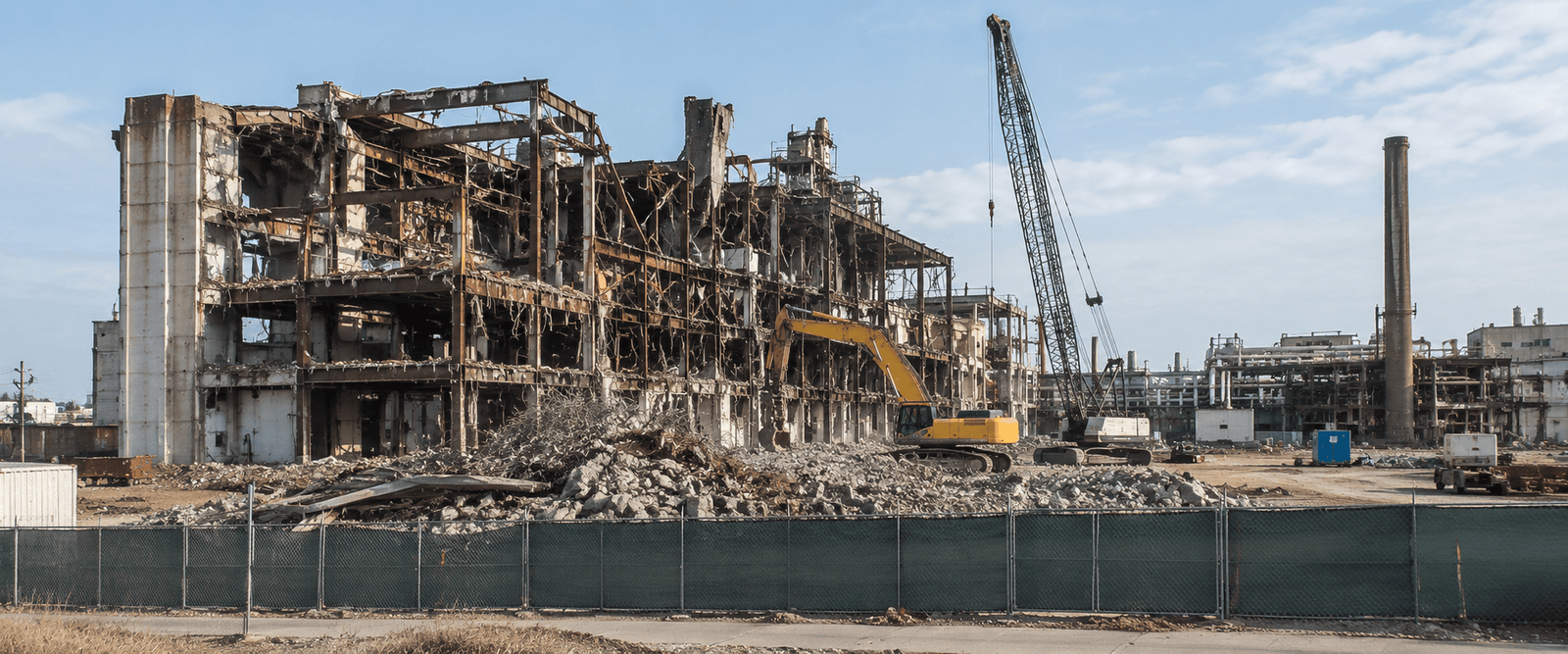
The regulatory changes above are catching up to a pattern already underway. In Pennsylvania, the owners of the former Homer City Generating Station, once the state’s largest coal-fired power plant, demolished its three cooling towers and four smokestacks in March 2025 and then announced plans for a natural gas-powered data center campus with on-site turbines designed to produce up to 4.5 gigawatts, the Associated Press reported. In Philadelphia, the city Planning Commission identified the 1,300-acre Bellwether District, a former refinery site whose previous owner shut down and went bankrupt after a 2019 fire, as one of only two sites in the city able to host a large data center, though neither the commission nor site owner HRP Group reported any data center proposal, according to an Inside Climate News report republished by Spotlight PA. In Lawrence County, Pennsylvania, developer Stonebridge Associates has proposed a 16-building data center campus on a 569-acre former dynamite factory site, according to Data Center Dynamics. New Jersey shows the other side of the pattern: Millville’s citywide ban stopped a proposed campus on a former glass factory site before it could start. Wherever a conversion does move forward, it begins with the same basic work: an engineering survey, utility isolation, an asbestos inspection, and a controlled teardown of the structure that occupied the site.
Site Prep and Demolition Checklist for Data Center Conversions
The permitting path changes by state and by project size, but the underlying site prep sequence for a data center conversion is consistent. Before mobilizing on any brownfield, industrial, or power plant site headed toward data center use, a contractor should confirm the following:
- Engineering survey completed and documented by a competent person before employees begin demolition, per 29 CFR 1926.850(a).
- All service lines shut off, capped, or otherwise controlled outside the building line, with involved utilities notified in advance, per 29 CFR 1926.850(c).
- Asbestos inspection completed for the affected facility, including Category I and Category II nonfriable material, before demolition begins, per 40 CFR 61.145(a).
- EPA notice postmarked or delivered at least 10 working days ahead, which demolition of a covered facility requires regardless of how much asbestos is found, per 40 CFR 61.145(b). Demolitions ordered because a structure is in danger of imminent collapse follow the shorter timeline in 61.145(b)(3)(iii).
- Local approvals confirmed early, since Pennsylvania ties state permit review or issuance to municipal approvals, New York’s pause leaves local permits in play, and New Jersey municipalities have used bans and stop-construction orders.
- State track identified before bidding: a New York DEC discretionary permit on hold for projects of 50 MW or more, a Pennsylvania GRID Consent Order or non-signer track for projects over 25 MW of peak demand, or a New Jersey project where local review governs siting.
- Documentation retained, including written evidence of the engineering survey, utility shutoff confirmations, and EPA notices, with updated notices filed when the amount of asbestos affected changes by at least 20 percent.
Bella Contracting Services handles commercial demolition and heavy demolition for industrial and commercial sites across New York, New Jersey, and Pennsylvania. Get a free estimate to talk through what a specific data center site requires before the first permit application goes in.
| State | Trigger | Mechanism | Local Approvals | Key Restrictions | Effective |
|---|---|---|---|---|---|
| New York | Facilities that consume or can consume 50 MW or more | DEC holds discretionary permit applications not deemed complete before July 14, 2026, until the final GEIS and findings are submitted | Not paused; local government permits are excluded | No fixed end date in the order text (press office: up to one year); manufacturing, research, education, and medical facilities excluded | July 14, 2026 (EO 62) |
| Pennsylvania | Peak demand over 25 MW (permit applications submitted after August 18, 2026) | Signed GRID Consent Order: rolling DEP review. No Consent Order: review starts only after local and water approvals are documented | Required. Signers: before permits issue. Non-signers: before review begins | Removed from PA Permit Fast Track; NDAs barred for agencies under the Governor’s jurisdiction; Clean Firm Energy schedule under the template Consent Order | August 18, 2026 (EO 2026-05) |
| New Jersey | Large data centers, with the size threshold set by the Board of Public Utilities at no more than 50 MW | Data Center Fair Share law (A796/S731): BPU sets utility standards for large data center customers within 12 months | Local zoning and construction approvals govern siting (Millville ban, Vineland stop-construction orders) | Costs attributable to large data center customers are allocated to them; priority curtailment before residential customers in system emergencies | Signed and effective July 7, 2026 (P.L.2026, c.32) |
Frequently Asked Questions
Does New York’s data center moratorium stop demolition work on data center sites? Not directly. Executive Order 62 pauses discretionary Department of Environmental Conservation permits for data center projects of 50 megawatts or more, but it expressly excludes permits and approvals from local governments, which typically include the building and demolition permits for site clearing. A contractor on a New York data center site should confirm which state and local permits the project needs rather than assuming all activity is frozen, since local approvals can move forward while a separate state discretionary permit sits on hold. The pause lasts until the state completes its Generic Environmental Impact Statement, not for a fixed period.
What triggers Pennsylvania’s GRID Consent Order requirement? Any Pennsylvania data center project with peak electric demand over 25 megawatts falls under Executive Order 2026-05 for permit applications submitted after August 18, 2026. A developer that signs a Consent Order and Agreement with the Department of Environmental Protection gets rolling permit review, but permits issue only after local approvals are documented. A developer that does not sign waits longer: review does not begin until local approvals and any required water authorizations are documented, and no permits issue until every required application has been received and reviewed. The threshold is based on the project’s peak electric demand, not its footprint or construction cost.
Is New Jersey’s Data Center Fair Share law already in effect? Yes. Governor Mikie Sherrill signed the Data Center Fair Share bill on July 7, 2026, and it took effect immediately as P.L.2026, c.32. According to the Governor’s office, it places data centers in their own ratepayer class so they pay for their own energy use and associated grid infrastructure, and it requires them to cut back before residential customers when the grid is strained. It is an electricity cost law rather than a permitting pause, so siting decisions still run through local review, where Millville has banned data centers and Vineland has issued stop-construction orders on a project already underway.
What federal rules apply before demolishing a building for a data center, regardless of state? Two federal rules apply regardless of state. EPA’s asbestos NESHAP, 40 CFR 61.145, requires a thorough asbestos inspection before demolition and written notice at least 10 working days before demolition of a covered facility begins, even when little or no regulated asbestos is found, with a shorter timeline for emergency demolitions ordered because a structure is in danger of imminent collapse. OSHA’s demolition standard, 29 CFR 1926.850, requires an engineering survey by a competent person, with written evidence, before employees start demolition, and requires utility service lines to be shut off, capped, or otherwise controlled before work begins. Both apply on top of any state or local data center rule.
Can an old power plant or industrial building actually be demolished and converted into a data center? Yes, and it is already happening in the region. In Pennsylvania, the former Homer City coal plant’s cooling towers and smokestacks came down in 2025 to make way for a natural gas-powered data center campus, and a 16-building campus has been proposed on a former dynamite factory site in Lawrence County. Conversions can also stall locally, as when Millville, New Jersey, banned data centers and blocked a proposed campus on a former glass factory site. Any conversion that proceeds still needs an engineering survey, utility isolation, an asbestos inspection, and controlled demolition. Get a free estimate from Bella Contracting Services to scope demolition and site prep for a data center property in New York, New Jersey, or Pennsylvania.