24/7 EMERGENCY SERVICE
By Ben Raabe, CEO — Licensed Contractor | 25+ Years Experience
Bella Contracting Services provides commercial snow removal across all 21 New Jersey counties, clearing parking lots, sidewalks, building entrances, loading docks and fire lanes at retail centers, office parks, industrial sites, warehouses, medical buildings and multi-tenant properties. Plowing, hand clearing, deicing and snow hauling run under a single contract and a single point of accountability, so a property manager is not coordinating a plow vendor, a sidewalk crew and a salt supplier separately at four in the morning. For portfolios with sites in more than one part of the state, that means one contract and one invoice instead of a different regional contractor in every market.
Get Your Free NJ Estimate
Licensed, insured, and available 24/7. Response within 24 hours guaranteed.
By submitting this form, you consent to be contacted by Bella Demolition and Contracting Services via phone, email, or text regarding your project inquiry. We respect your privacy and will never share your information.
View our Privacy Policy.
In a hurry?
A complete commercial snow operation covers far more surface than the parking lot. Bella clears drive aisles, parking stalls, sidewalks, entrances, stairs, loading docks, fire lanes and the accessible parking spaces and access aisles that a plow cannot legally block, then treats those surfaces so they stay clear through the freeze that follows the storm. Every service below can run as part of one site contract rather than as a separate vendor relationship.
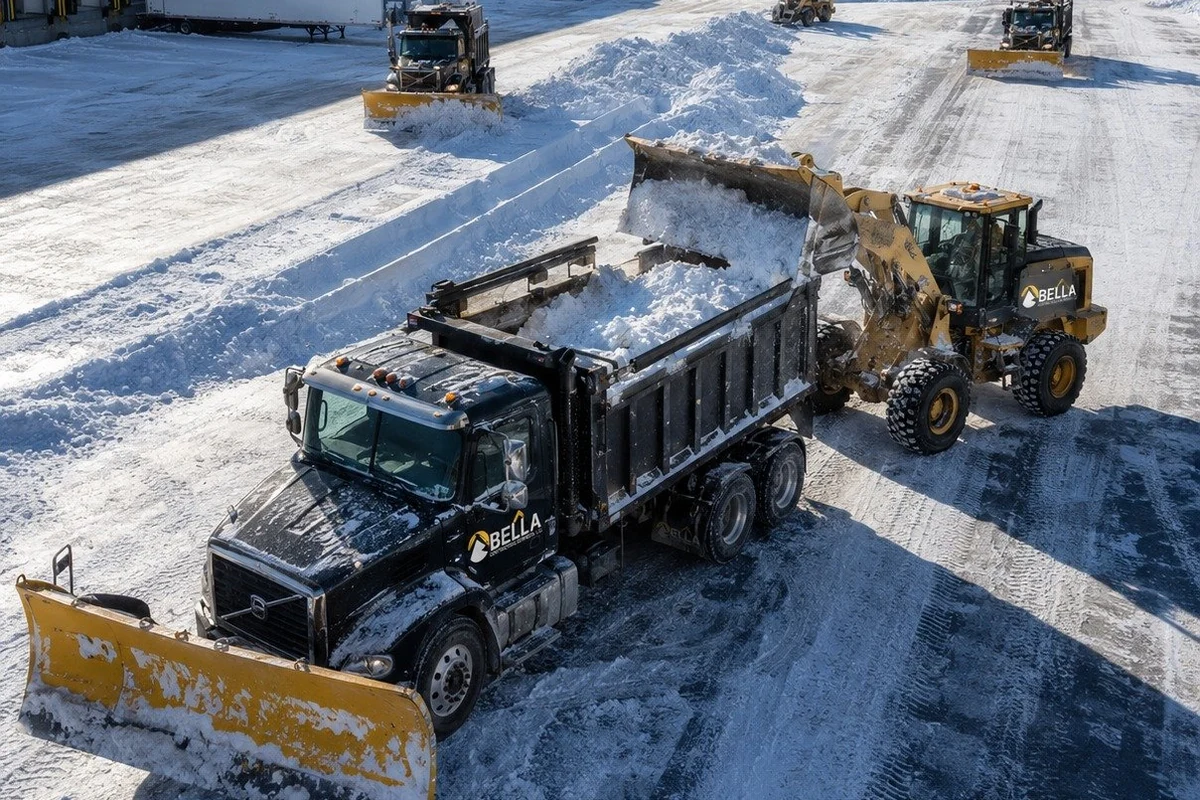
Plowing is scheduled against accumulation triggers rather than run once at the end of a storm. On a long-duration event crews clear in passes, so the lot never holds more snow than the equipment can move cleanly and the property stays usable while the storm is still running. Snow is stacked at points designated before the season that keep sight lines open at exits, keep meltwater away from entrances, and avoid burying the accessible parking spaces that a property is least able to lose.
Sidewalks, building entrances, stairs and dock aprons are cleared by crews on foot with walk-behind equipment and hand tools, because plow equipment cannot service them safely or completely. These are the surfaces where slip-and-fall exposure actually concentrates on a commercial property, and they are the surfaces most often handed to a separate vendor or left to on-site staff who are not equipped, insured or scheduled for it at five in the morning.
Deicing is applied after clearing to break the bond between remaining ice and the pavement. Anti-icing is applied before a forecast event so that bond never forms, which cuts the total material needed and shortens post-storm clearing time. Material is selected against pavement temperature and surface type rather than air temperature, because the wrong product below its working range will not activate, will not clear the surface, and will still damage concrete, landscaping and adjacent turf. Poorly drained lots that cycle through freeze and thaw all winter are also the lots that eventually generate a water damage restoration call.
On dense or fully built-out sites there is nowhere left to stack snow after the second or third storm of a season, and the piles that remain start taking parking capacity into March. Bella loads and hauls accumulated snow off site so a property does not spend the back half of winter operating at reduced capacity. This is also the service that keeps a property compliant with New Jersey's snow dumping statute, covered in the next section.
Crews are on call through winter weather events, including overnight, weekends and holidays, so a property is cleared before its first shift, first delivery or first customer arrives rather than after. Emergency callouts are available between storms for conditions that are not a snowfall event at all: an overnight refreeze, roof-melt runoff icing an entrance, or a failed downspout turning a walkway into a hazard.
Commercial snow removal in New Jersey is priced under four common contract structures, and the right one depends on how much budget certainty a property needs and how little snow it can tolerate before it is exposed. Bella prices each property individually after a pre-season site walk rather than quoting from square footage alone, because stacking capacity, drainage, dock access, pedestrian volume and overnight operating hours change the cost of servicing two lots of identical size.
The property is billed each time crews clear the site. Cost tracks actual snowfall exactly, which makes it the most efficient structure in a light winter and the least predictable in a heavy one. It suits properties that can absorb budget variance across a season.
Pricing steps up in accumulation bands, so a two-inch event and a ten-inch event bill differently. This prices heavy events more fairly than per-push and gives a property a usable cost model to run against a snowfall forecast.
One fixed price covers the entire winter regardless of how many events occur. Budget certainty is complete and the number is locked before the season starts. This is the structure most often chosen by properties running on a fixed annual facilities budget where a variable line item is the problem, not the amount.
Crews stay on site or on immediate standby through the event and clear continuously so accumulation never reaches a trigger depth. It is the highest service level and the highest cost, and it is used where surfaces must stay bare at all times: hospitals and urgent care, distribution centers running overnight shifts, and sites with heavy pedestrian traffic and low risk tolerance.
New Jersey law prohibits a commercial snow contractor from pushing snow off private property onto a public road. The Anti-Snow Dumping Act, signed into law on August 18, 2011 as P.L. 2011, c.110 and codified at N.J.S.A. 39:4-77.3, states that the commercial operator of any snowplow or other snow removal equipment clearing accumulated snow on private property shall not deposit that snow on any public road, street or highway in the State, or on public lands. The fine is $250 for a first offense and $500 for every offense after that.
That is a rule about where the snow ends up, and it is the reason stacking capacity has to be planned before the first storm rather than improvised during the fourth. A contractor who runs out of room on a built-out site and starts pushing into the street creates three problems at once: a statutory violation, a sight-line hazard at the curb cut, and a refreeze that migrates straight back onto the property. It is also the most common corner cut in low-bid commercial snow work, and it is invisible to an owner who is not standing in the lot at three in the morning watching it happen.
Bella designates stacking locations during the pre-season site walk and hauls snow off site once a property runs out of capacity. On dense urban sites and fully built-out suburban lots in New Jersey, hauling is not an upgrade to the service. It is the only compliant way to keep clearing after the second or third storm of a season.
Most of the work that determines how a commercial property performs in a storm happens before the storm starts. Bella runs every site through the same four phases.
1
Before the season, crews walk the property and map it: plow routes and pass direction, snow stacking locations, drainage points and low spots, dock and fire lane access, accessible parking spaces and access aisles, and any surface that needs hand clearing rather than equipment. Trigger depths, service priorities and the contract structure are set from that walk, not from a satellite image.
2
Forecasts are tracked ahead of each event so crews and material are staged before precipitation starts rather than dispatched after it. Where conditions call for it, surfaces are pre-treated so ice never bonds to the pavement in the first place.
3
On anything longer than a short event, crews clear in passes so the property stays usable while the storm runs and the equipment is never asked to move more snow than it can handle cleanly. Lots, walkways, entrances and docks are worked to the priority order set in Phase 1, so the surfaces the property needs first are the surfaces cleared first.
4
After the event, crews walk the site again for the conditions that appear hours later rather than during the storm: refreeze at low points, meltwater tracking across a cleared walkway, snow banks blocking sight lines at exits, and drifting. Written service records covering time on site, surfaces treated and material applied are available on request.
One vendor for the whole state. Most New Jersey snow contractors run a regional footprint: North Jersey, Central Jersey, the Shore, or a county cluster. A property manager with sites in Paramus, Edison and Toms River is usually running three contracts, three insurance certificates and three sets of invoices. Bella services commercial properties in all 21 New Jersey counties under one contract.
Owned equipment and crews, not a broker. Bella runs its own crews and its own heavy equipment rather than subcontracting the work to whoever is available the night of a storm. The crew on site in January is the same operation that runs Bella’s demolition and site work the rest of the year.
Licensed and insured, with the paperwork ready. Bella is a fully insured, licensed New Jersey contractor with more than 25 years in business. Certificates of insurance and the compliance documentation a property manager or REIT needs before a vendor sets foot on site are supplied as part of onboarding, not chased down in December.
Commercial and industrial first. Bella does not run residential driveways. Every crew, every piece of equipment and every service level on this page is built around commercial, industrial and multi-tenant property, which is a different job from clearing a driveway with more trucks.
A site plan that accounts for the property, not just the snow. Twenty-five years of demolition, excavation and site work means a Bella snow plan reads grade, drainage and surface condition, not just square footage. On a lot that ices in the same place every year, that is the difference between treating the symptom every week and fixing the cause once.
Bella provides commercial snow removal in every New Jersey county. Crews and equipment are staged regionally rather than dispatched from one yard, so a property in Cherry Hill is not waiting on a truck leaving Bergen County when the storm starts at two in the morning. Portfolios with sites in more than one region run on a single contract.
Bella clears commercial properties throughout Bergen, Passaic, Essex, Hudson, Morris, Sussex, Warren and Union counties. That covers Hackensack, Fort Lee, Fair Lawn, Teaneck, Englewood and Ridgewood in Bergen County; Clifton, Paterson, Wayne and Hawthorne in Passaic County; Newark, Montclair, Bloomfield, West Orange, Belleville and Nutley in Essex County; Jersey City, Bayonne and North Bergen in Hudson County; Morristown, Parsippany, Randolph and Rockaway in Morris County; and Elizabeth, Union, Westfield, Summit and Linden in Union County. Dense urban sites in Hudson and Essex almost always need off-site hauling by mid-season, because there is no stacking capacity left once the lot fills. The same crews that run Bella's commercial demolition work across North Jersey run the winter operation, so site knowledge carries from one season to the next.
Bella clears commercial properties throughout Middlesex, Somerset, Hunterdon, Mercer and Monmouth counties. That covers Edison, East Brunswick, Woodbridge, Old Bridge and Piscataway in Middlesex County; Bridgewater, Hillsborough and Somerset in Somerset County; Hamilton, Trenton, Princeton and Lawrenceville in Mercer County; and Freehold, Middletown, Marlboro, Manalapan and Hazlet in Monmouth County. Corporate campuses, distribution facilities and pharmaceutical sites along this corridor typically run zero-tolerance or tiered per-inch contracts, because their operations do not stop for weather. Many are properties Bella already knows from commercial construction work in the same corridor.
Bella clears commercial properties throughout Ocean, Burlington, Camden, Gloucester, Salem, Atlantic, Cumberland and Cape May counties. That covers Toms River, Brick, Jackson, Howell, Lakewood and Manahawkin in Ocean County; Cherry Hill, Voorhees and Marlton in the Camden County corridor; Medford, Mount Laurel and Willingboro in Burlington County; and Vineland, Galloway, Atlantic City and Ocean City to the south. Shore properties carry a specific problem inland sites do not: wind-driven drifting reburies a cleared lot within hours of the crew leaving, which is why service triggers on coastal sites are set on wind as well as accumulation. Sites that ice repeatedly at the same low point are usually a storm drain installation problem rather than a plowing problem, and Bella can address the drainage in the off-season instead of salting the same corner every winter.
Seasonal capacity is committed before winter starts. Properties should schedule a pre-season site walk rather than calling during the first storm, when routes are already assigned. Bella’s full New Jersey service footprint is listed on the New Jersey locations page, alongside its general contracting and year-round site services.
Snow work is not the same job in every part of New Jersey. A shore retail center, a Hudson County high-rise and a Turnpike distribution terminal fail in different ways during the same storm, and the plan for each starts from a different constraint. These are the six New Jersey markets Bella services most heavily.
Shore properties carry a problem inland sites do not: wind reburies a cleared lot. On an exposed Ocean County site, drifting can undo a finished parking lot within hours of the crew leaving, which is why service triggers on coastal properties are set against wind as well as accumulation, and why a single clearing pass is rarely the end of the job. The strip retail and medical office density along the Route 37 and Route 9 corridors also means most Ocean County sites are shared-tenant properties where one blocked entrance affects six businesses at once. Occupancy swings hard between seasons here, so a lot that is a third full in February is at capacity by Memorial Day, and stacking locations have to be chosen for the busy case rather than the empty one.
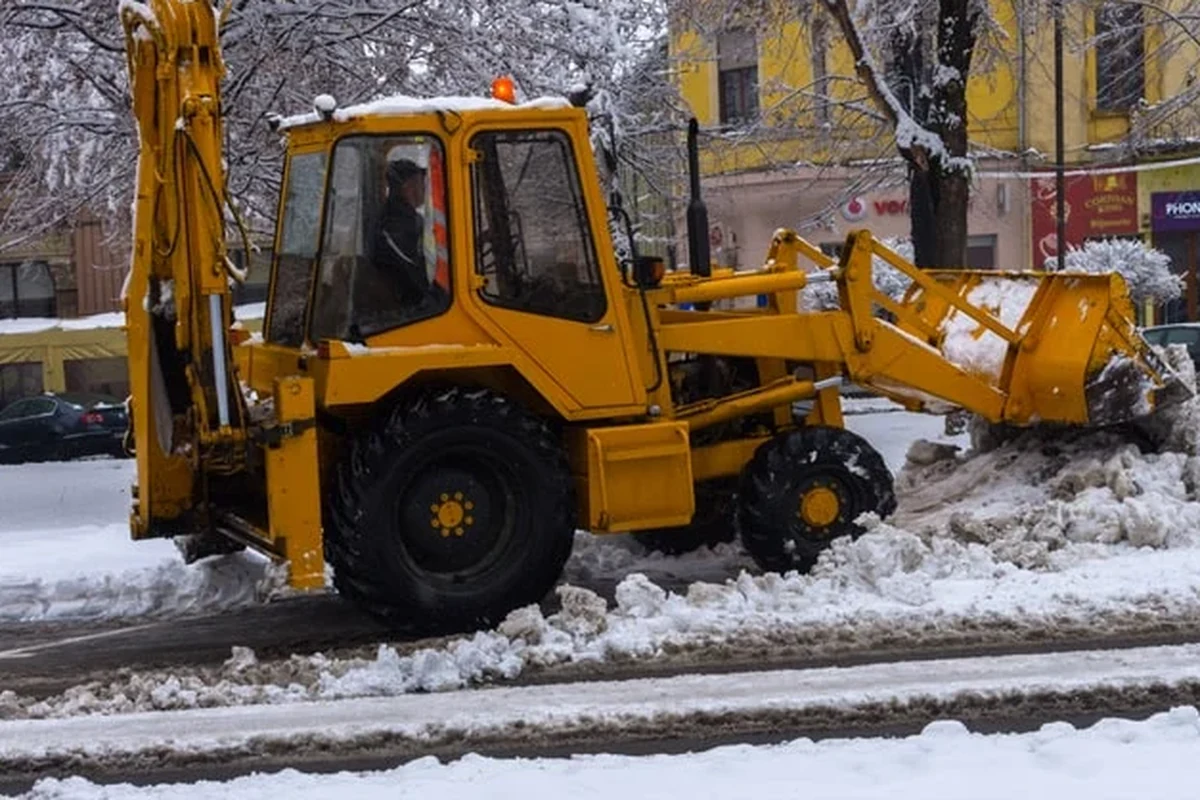
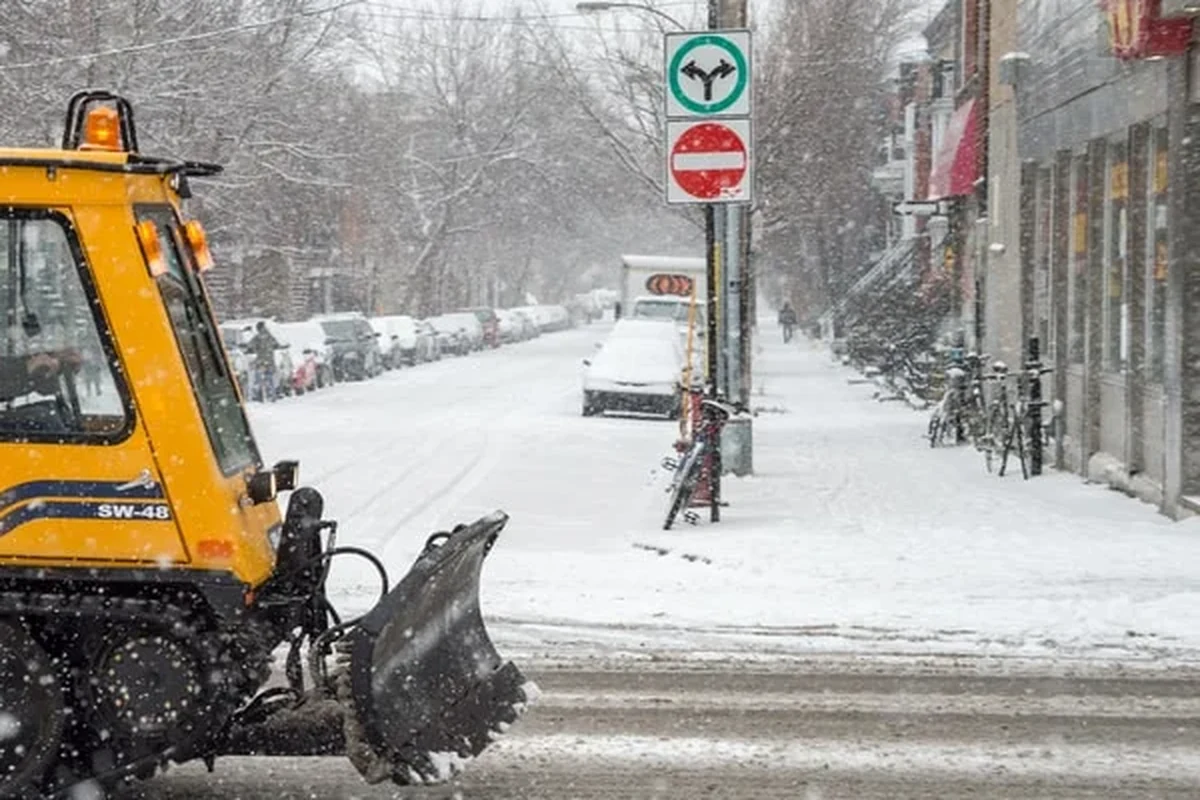
Hudson County is the hardest snow market in New Jersey, and the reason is geometry rather than snowfall. High-rise, mixed-use and structured-parking properties have little or no adjacent open ground, which means there is frequently nowhere on site to put the snow at all. Off-site hauling is not a premium upgrade on these properties, it is the only way to clear the second storm of a season. It is also where the Anti-Snow Dumping Act exposure described above concentrates: when a site has no capacity and the street is ten feet away, pushing into the roadway is the path of least resistance, and it is a statutory violation with a curb-line hazard attached. Loading zones, ramp entrances and parking deck approaches are cleared by hand and by compact equipment, because full-size plow equipment cannot work them.
Bergen County is Bella's home market. The company operates out of Fair Lawn, which means mobilization time to a Bergen County property is measured in minutes rather than in how long it takes a truck to come down from another region. The large-format retail along the Route 4 and Route 17 corridors is the defining property type here: wide lots, long sidewalk runs, multiple entrances, and heavy pedestrian volume on weekend mornings, which puts the pressure on entrance and walkway clearing rather than on the lot itself. Sites this size also fill their own stacking capacity quickly, so pass direction and stacking points are set at the pre-season walk rather than decided by whoever is driving.
Ben Raabe, CEO, on a February storm call:
Last February a storm rolled in that started as rain and turned to heavy wet snow around 2 a.m. One of our commercial clients in Bergen County manages a multi-tenant office and light-industrial complex, a big lot with several walkway systems that need to stay open for early shift workers. Their property manager texted me at 1:40 a.m. He wasn’t panicking, we’ve worked together for years, but he was clear: the first trucks and employees start arriving at 5:30, and he needed the main lot and entrances clear and treated.
We had the forecast locked in and a crew already staged, so we were on site as soon as the snow started sticking. Drives and parking lanes came first, then the walkways and loading areas, then treatment so the ice didn’t become the bigger problem later that morning. When he showed up at 5:15 the lot was open and safe. He walked it with me for a few minutes, nodded, and said, “This is why we don’t shop it every season.”
That’s the part of the job that matters most to me. Commercial properties can’t afford to wait and see. Tenants, employees and deliveries don’t care that it snowed six inches overnight. They just need the site open and safe, and that’s what we make sure of.
Essex County runs two different snow jobs in the same county. The industrial and logistics properties near the port and airport corridor operate through the night and through the storm, so their surfaces have to stay workable continuously rather than be cleared once at dawn, and their truck courts and dock aprons need equipment that a retail lot never requires. The urban core is the opposite problem: older street grids, tight loading access, limited staging room for equipment, and institutional and medical properties that cannot close. Both need clearing scheduled around operations rather than around the storm.
Monmouth County is geographically wide and splits into two conditions. Inland, the office parks and medical campuses are large-lot properties with predictable clearing patterns and a hard weekday-morning deadline. On the eastern edge, shore properties inherit the same wind-driven drifting that Ocean County sites deal with. The retail corridors along Route 35 and Route 36 sit between the two. The practical consequence is that Monmouth work is a routing problem more than a technique problem, and route sequencing is set before the season so that the properties with the earliest opening times are cleared first.
The Turnpike Exit 10 corridor through Edison and the surrounding townships is one of the densest logistics concentrations in the Northeast, and warehouse and distribution properties are a different surface problem from a retail lot. Truck courts, trailer parking areas and dock aprons are large, heavily trafficked, and unforgiving of partial clearing, because a trailer that cannot back into a dock stops the building. Most of these properties run on zero-tolerance or tight tiered contracts, since freight moves overnight and a distribution center does not have a closed hour to be cleared in. Corporate campuses and pharmaceutical properties elsewhere in Middlesex County run the same way for different reasons.
Commercial snow removal in New Jersey covers plowing the drive aisles and parking stalls, clearing sidewalks, entrances, stairs and loading docks by hand, applying deicing or anti-icing material to treated surfaces, and hauling accumulated snow off site when a property runs out of stacking capacity. Bella Contracting Services handles all of these under a single site contract rather than splitting them across separate vendors. Accessible parking spaces and access aisles are cleared as part of the same pass, not left for a follow-up visit.
A per-push contract bills the property each time crews clear the site, so cost tracks actual snowfall and varies widely between a light winter and a heavy one. A per-inch contract prices in accumulation bands, so a two-inch event and a ten-inch event bill differently. A seasonal contract sets one fixed price for the entire winter regardless of how many storms occur, which gives complete budget certainty before the season starts. Bella Contracting Services prices each property individually after a pre-season site walk rather than quoting from square footage alone.
No. New Jersey’s Anti-Snow Dumping Act, codified at N.J.S.A. 39:4-77.3, prohibits the commercial operator of a snowplow or other snow removal equipment clearing private property from depositing that snow on any public road, street or highway in the State, or on public lands. The fine is $250 for a first offense and $500 for each offense after that. This is why stacking locations are designated before the season starts and why snow is hauled off site once a property runs out of capacity.
Bella Contracting Services provides commercial snow removal in all 21 New Jersey counties, covering retail centers, office parks, industrial sites, warehouses, distribution centers, medical buildings and multi-tenant properties across North Jersey, Central Jersey, the Shore and South Jersey. Residential driveways are not serviced in any market. Portfolios with properties in more than one region run under a single contract rather than a separate contractor in each region.
Yes. Bella Contracting Services provides commercial snow removal in Jersey City, Newark, Edison and Toms River, along with Bergen County, Monmouth County and every other New Jersey market. Each of these markets has its own section on this page describing the conditions crews plan for, from wind-driven drifting that reburies cleared shore lots in Ocean County to the near-zero snow stacking capacity typical of Jersey City high-rise and structured-parking properties. Call (201) 275-4847 for a free estimate.
Still Have Questions?
Our team is here to answer all your questions and provide expert guidance for your project. Let’s talk!