24/7 EMERGENCY SERVICE
By Ben Raabe, CEO — Licensed Contractor | 25+ Years Experience
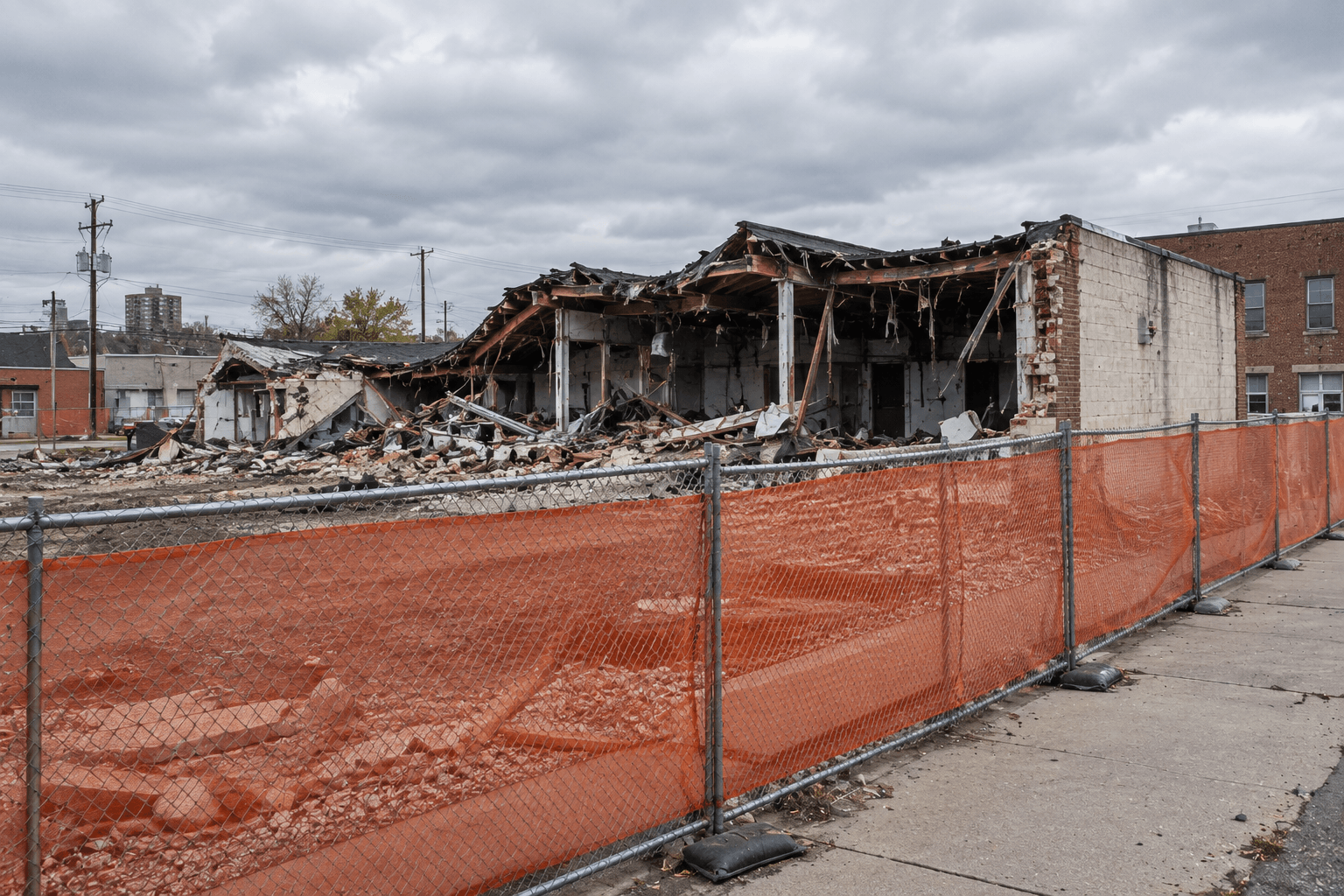
Emergency demolition is the controlled, rapid removal of a structure that has become dangerous enough that leaving it standing is the greater risk. Bella Contracting Services responds around the clock when a commercial building is compromised by fire, flood, storm damage, or structural failure. Crews secure the site, coordinate with local authorities on expedited permitting where it is required, and bring the structure down before it puts adjacent properties or the public at risk. Licensed, fully insured, and experienced on union, federal, and prevailing wage projects.
Get a Free Emergency Demolition Estimate
Licensed, insured, and available 24/7. Response within 24 hours guaranteed.
By submitting this form, you consent to be contacted by Bella Demolition and Contracting Services via phone, email, or text regarding your project inquiry. We respect your privacy and will never share your information.
View our Privacy Policy.
A demolition is an emergency when a structure has failed, or is close enough to failing, that the danger it creates cannot wait for a standard project timeline. The judgment is about risk to people and neighboring property, not about how badly damaged the building looks.
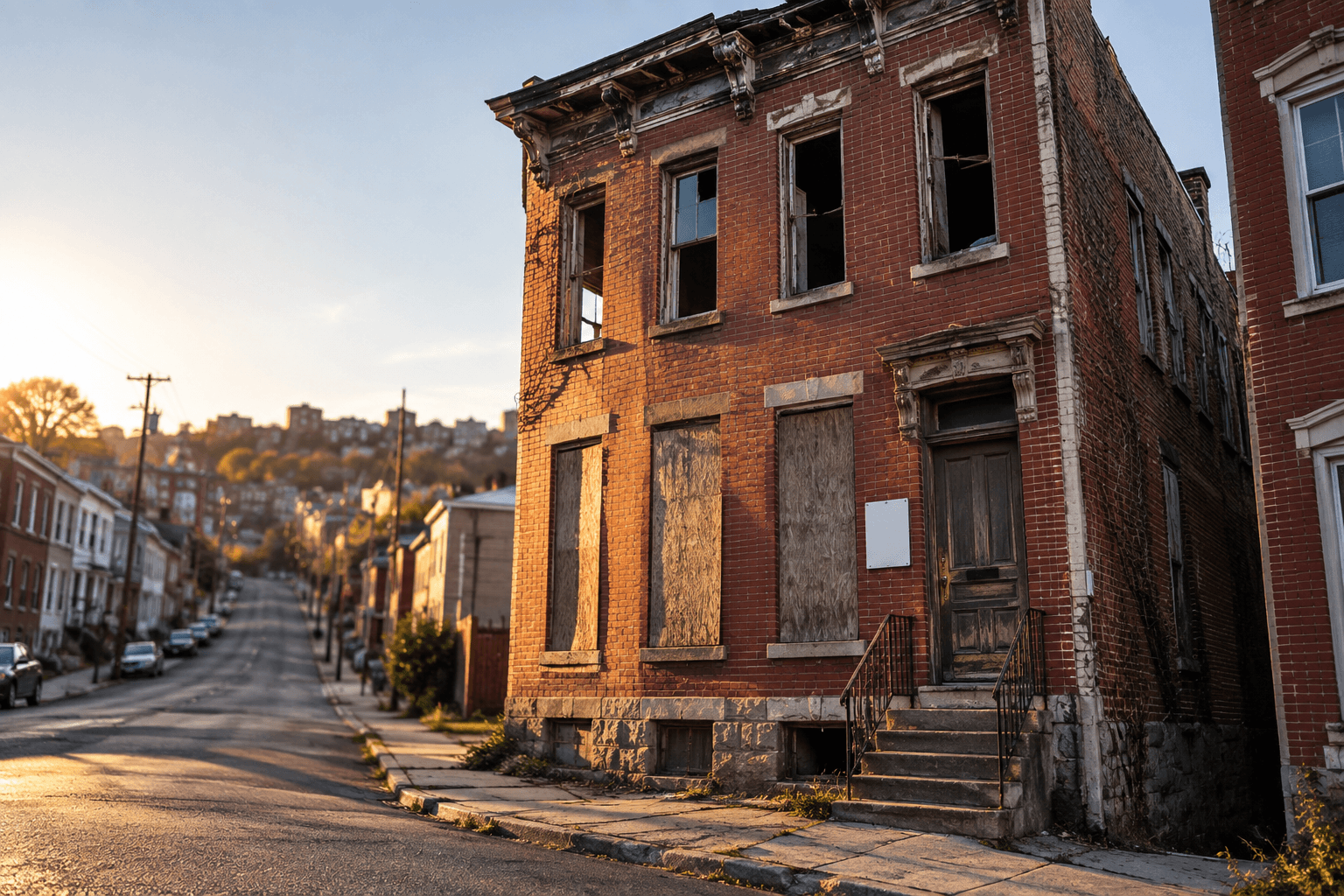
The situations that most often trigger emergency work are a partial or full collapse, a fire that has burned through load-bearing elements, flood or storm damage that has undermined a foundation, a facade or parapet shedding material onto a sidewalk, and long-term decay in an abandoned building that has finally reached the point of instability. An explosion, a vehicle strike, or a failed excavation next door can do the same thing in minutes.
Bella takes emergency calls across its full range of demolition services, covering commercial, industrial, institutional, and municipal properties, with select residential emergencies handled case-by-case. Work is prioritized ahead of the standard scheduling queue and crews mobilize rapidly once the site is cleared for entry.
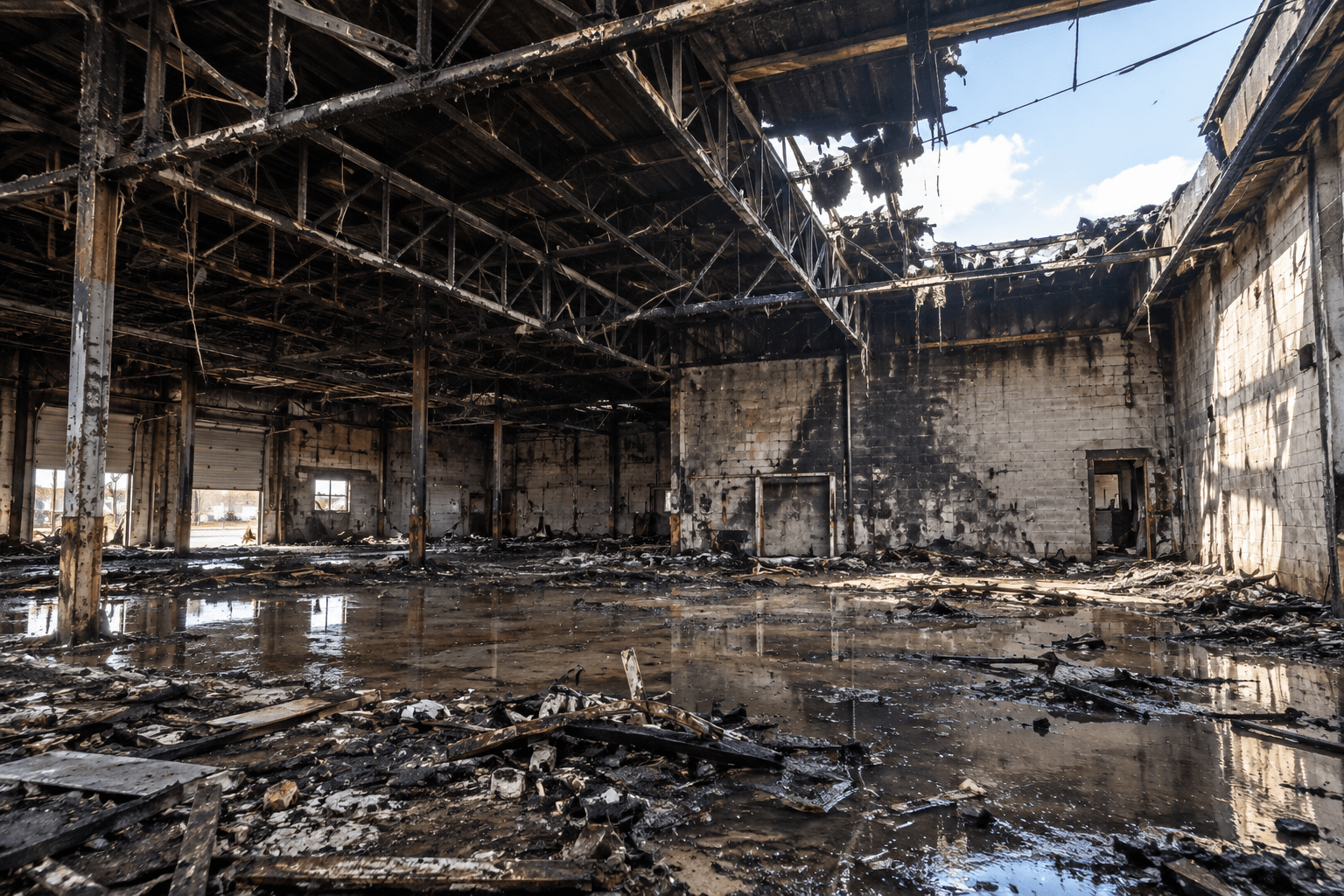
A fire-damaged commercial building usually cannot be assessed the day the fire is out, and it often cannot be saved. Heat that reaches structural steel or burns through timber framing changes the load path permanently, and water used to fight the fire adds weight and saturation the structure was never designed to carry.
The standard industry sequence is an engineer’s structural assessment first, then a hazardous materials survey, then the demolition or partial demolition itself. Buildings that predate modern abatement rules frequently contain asbestos in insulation, flooring, or fireproofing, and fire tends to disturb exactly the materials a survey needs to find. Insurance adjusters generally want the damage documented before anything comes down, which is why the order of operations matters as much as the speed.
Bella handles fire damage demolition for commercial and industrial properties, including selective removal where only the fire-affected portion of a structure has to come out and the rest can be stabilized and rebuilt. Because Bella performs demolition and rebuild work under a single contract, the same team that removes the damaged structure can carry the site straight into reconstruction instead of handing it off. Fire damaged house demolition is handled case-by-case rather than as a marketed service line.
Speed on an emergency demolition is almost never limited by equipment availability. It is limited by three things: whether the site is safe to enter, whether the utilities feeding the building have been cut and released, and whether the local code official has issued or waived the paperwork that lets work begin.
Utilities are the step that most often stalls a job. Gas, electric, water, and sewer connections all have to be disconnected and confirmed by the utility itself, and in most jurisdictions a written release from each provider is a condition of the demolition permit rather than a courtesy. Bella’s guide to disconnecting utilities walks through what that sequence looks like provider by provider in New Jersey, and the same pattern holds across most of the service area.
The second gate is structural. A building that is actively shifting cannot be entered to disconnect anything, which sometimes means shoring or partial removal has to happen before the routine steps can. The third is jurisdictional, and it varies more than most owners expect. Pittsburgh is a useful worked example.
Pittsburgh runs emergency demolition through the Department of Permits, Licenses, and Inspections, under the 2021 International Property Maintenance Code, which the city adopted into Title 10, Chapter 1004 of its own code. PLI’s director is the code official named in that ordinance.
Two separate things can happen when a Pittsburgh structure becomes dangerous. If PLI judges there is imminent danger of failure or collapse that endangers life, the code official can order the building vacated immediately and post a notice at each entrance stating that occupancy has been prohibited. Where the city itself performs or contracts emergency work, the ordinance has the jurisdiction pay the cost up front and then recover it from the owner, charged against the real estate as a lien.
If the owner is doing the demolition, a PLI demolition permit is still required, and Pittsburgh adds requirements the base code does not. Every demolition permit carries three mandatory PLI inspections: a pre-inspection, a void inspection, and a final inspection. No work may start before the pre-inspection. Before the structure comes down, the owner or the owner’s agent has to notify every utility with a service connection and obtain a release confirming the equipment has been removed or sealed and plugged safely, and that release goes to the PLI inspector. Written notice to adjoining property owners is a condition of the permit being issued at all.
The practical takeaway for a Pittsburgh owner staring at a condemned building: the permit is not the bottleneck, the utility releases and the pre-inspection are. Bella’s emergency demolition crews work those two items in parallel with mobilization rather than in sequence after it.
Bella takes emergency demolition calls across its full service footprint, not only in the markets where it holds a physical office. That footprint covers New Jersey, New York, Connecticut, Pennsylvania, Maryland, Illinois, Ohio, Kentucky, Texas, Michigan, and the District of Columbia.
Pittsburgh is the one market where emergency demolition generates meaningful, measurable local search demand, and it is also the market with the most distinctive process, which is why it gets its own section above. Everywhere else, the pattern is the same: the local code official controls the timeline, and the contractor’s job is to clear the site’s gates fast enough that the structure comes down before it takes something else with it.
Offices sit in Fair Lawn, New Jersey; Manhattan; Stamford, Connecticut; and Pittsburgh. Crews travel to projects outside those metros regularly, and demolition in Pittsburgh, commercial demolition nationwide, and water damage restoration work all run through the same scheduling desk.
The first hours after a collapse or a major fire decide how long the rest of the job takes. Standard practice across the demolition industry runs roughly in this order.
Get everyone out and keep them out, including staff who want to retrieve equipment. Call the fire department or building department even if the fire is already out, because in most jurisdictions their inspection is what starts the official clock. Establish a perimeter well beyond the building’s own footprint, since facade material falls outward. Notify the insurance carrier the same day and ask what documentation they need before anything is removed. Start the utility disconnection calls immediately, because those take the longest and nothing else can finish until they do. Get a licensed structural engineer on site to say what is holding the building up and what is not.
Then call a demolition contractor who can take the whole sequence from there. Bella’s emergency team coordinates with local authorities on expedited permitting where it is required, secures the structure, and removes it before it creates a second incident.
Emergency demolition is a trust purchase made under pressure, usually by someone who has never bought one before. Three things tend to decide it.
The first is whether the contractor can legally do the work at the scale in front of them. Bella holds New York General Contractor License #624832 with no height restriction, which matters when the compromised structure is a high-rise rather than a two-story building.
The second is whether the job is a public one. A municipal, federal, or authority-owned building brings Davis-Bacon Act and prevailing wage obligations, and frequently a Project Labor Agreement, into a situation where nobody has time to figure out compliance from scratch. Bella works union, federal, and prevailing wage projects as normal course, so those requirements do not add days to the front of an emergency job.
The third is what happens after the structure is down. Bella performs demolition and rebuild under a single contract, which means an owner facing an insurance-funded reconstruction is not re-bidding the site to a second contractor while the lot sits open.
Fully insured. 100+ verified reviews across all locations.
A building qualifies for emergency demolition when its condition creates an immediate risk to people or neighboring property that cannot wait for a normal project schedule. Typical triggers are partial or full collapse, fire damage to load-bearing elements, flood or storm damage that has undermined the foundation, facade material falling into a public right of way, and advanced structural decay in an abandoned building. In most jurisdictions the determination is made by the local code official rather than the owner, and it is usually documented as an unsafe-structure or imminent-danger finding.
No. Whether a fire-damaged commercial building has to come down depends on what the fire reached, not on how much of it burned. Fire that compromises structural steel, load-bearing masonry, or primary timber framing generally makes full or partial demolition the only safe outcome. Fire confined to finishes, contents, or a single non-structural bay often leaves a building that can be stabilized and rebuilt. A licensed structural engineer makes that call after inspecting the building, and selective demolition of only the affected portion is a common middle path.
It depends on who performs the work. When a property owner hires a contractor to remove a dangerous structure, the owner pays directly, and an insurance policy often covers part of it. When the municipality performs or contracts the demolition itself because the owner has not acted, the jurisdiction typically funds the work up front and then recovers the cost from the owner. In Pittsburgh, the adopted property maintenance code has that cost charged against the real estate and collected as a lien on the property.
Generally no, and the exceptions are narrower than most owners assume. A demolition permit from the local building department is required even when a structure is actively dangerous, and jurisdictions add their own conditions on top of it. Pittsburgh requires a pre-inspection by its Department of Permits, Licenses, and Inspections before any work begins, plus a void inspection and a final inspection later. The realistic path to starting fast is not skipping the permit, it is working the permit’s conditions in parallel with mobilization rather than one after the other.
Every utility serving the building has to be disconnected, and the disconnection has to be confirmed in writing by the provider. Gas, electric, water, and sewer are the standard four, and telecom or steam connections apply on some commercial sites. Pittsburgh requires the owner or the owner’s agent to obtain a release from each utility stating that its service connections and appurtenant equipment have been removed or sealed and plugged safely, and to submit those releases to the city inspector. Utility releases are usually the single slowest step in an emergency demolition timeline.
Bella Contracting Services takes emergency demolition calls around the clock and prioritizes them ahead of the standard scheduling queue. The team coordinates with local authorities on expedited permitting where it is required, secures the structure and the surrounding site, and removes the dangerous portion or the full building before it puts adjacent properties or the public at risk. Crews work commercial, industrial, institutional, and municipal properties across the full service area, with select residential emergencies handled case-by-case. Call (855) 368-3366, or use GET A FREE ESTIMATE to start a scoped quote.

Still Have Questions?
Our team is here to answer all your questions and provide expert guidance for your project. Let’s talk!