24/7 EMERGENCY SERVICE
By Ben Raabe, CEO — Licensed Contractor | 25+ Years Experience
Bella Contracting Services is a commercial general contractor in Cleveland, Ohio, taking the prime contract on buildouts, renovations, and ground-up commercial construction across Cuyahoga County. Bella files the permits with the City of Cleveland or the local building department, schedules every trade, and answers for cost and schedule from the first day of demolition through final inspection. Because Bella self-performs demolition, a project that starts by taking part of a building out and ends by building it back stays under one contract. Fully insured, Davis-Bacon compliant, and 25+ years on commercial and industrial work.
Get a Free General Contractor Cleveland Estimate
Fully insured and available 24/7. We typically respond to project inquiries within one business day.
By submitting this form, you consent to be contacted by Bella Demolition and Contracting Services via phone, email, or text regarding your project inquiry. We respect your privacy and will never share your information.
View our Privacy Policy.
On a commercial job, the general contractor is the party the owner actually hires to deliver the building. It prices the full scope, obtains the permits, contracts and sequences the trades, controls site safety, and closes out with the inspector. Everything else on the project runs through that one agreement, so the owner manages a single relationship instead of a stack of separate trade contracts.
That is the role Bella Contracting Services takes on Cleveland commercial projects. Bella’s own project leads run the schedule, and Bella self-performs the demolition and structural scope rather than brokering it to the lowest bidder. Bella’s commercial general contracting follows the same model in every market it serves.
The practical difference shows up when conditions change mid-project. When one general contractor holds every trade contract, a hidden condition behind a wall or a failed inspection gets resolved inside one contract and one schedule, rather than argued between separate firms over whose scope it was.
Ohio does not issue a state license for general contractors. The Ohio Construction Industry Licensing Board licenses five trades: heating, ventilating, and air conditioning, refrigeration, electrical, plumbing, and hydronics, as defined in Ohio Revised Code 4740.01. On a Cleveland commercial job, those are the trade contractors who hold state license numbers, and the general contractor is not one of them.
The credential that governs general contracting inside city limits is municipal. Under Cleveland Codified Ordinances Section 3107.02, no contractor may perform general contracting, demolition, or the listed mechanical trades in the City of Cleveland without a current Certificate of Registration or Limited Certificate of Registration for the type of work. The same section allows the city to issue a building permit only to a registered contractor, or to a homeowner exempted from registration.
For an owner, that makes the Cleveland Certificate of Registration the first document to request from any general contractor bidding city work, followed by current certificates of general liability and workers compensation insurance issued directly by the insurer.
In Cleveland, Bella takes on the same commercial building types it delivers across its other markets, with demolition, site preparation, and the build itself handled by one contractor.
Retail and restaurant work includes tenant improvement and storefront fit-outs, food service rough-ins, and certificate of occupancy coordination with the local authority. Office work runs from core and shell delivery for lease-ready space to open plan and private office build-outs for corporate tenants.
Industrial and warehouse projects for manufacturing, distribution, and logistics users bring heavy slab work, dock and overhead door rough-ins, and site grading and utility infrastructure. Healthcare and institutional work includes medical office and clinic build-outs and phased renovation of occupied buildings under infection control risk assessment protocols. Multi family and mixed-use developments at commercial scale round out the range.
Each project type, with the capabilities behind it, is laid out on Bella’s commercial construction capabilities page.
Commercial building permits in Cleveland are issued by the Division of Construction Permitting within the Department of Building and Housing, and applications are filed through the city’s online Permit Portal. Since April 13, 2026, the city no longer accepts paper plans or paper applications, so drawings, applications, and review responses all move electronically.
The code behind plan review is the Ohio Building Code, Ohio Administrative Code Chapter 4101:1, which the Ohio Board of Building Standards adopts and amends. It incorporates the 2021 International Building Code by reference, with Ohio modifications, and the Board certifies the municipal, county, and township building departments that enforce it.
Bella prepares and submits the permit application as part of the general contracting scope and builds plan review into the construction schedule, so the owner is not chasing review comments while a start date slips.
Renovation and demolition on commercial buildings bring asbestos rules into play before any wall comes down. The City of Cleveland’s air quality program directs owners and asbestos contractors to submit the notification for a demolition or renovation that may involve asbestos to Ohio EPA, and Ohio Administrative Code 3745-20-03 requires that notice at least ten working days before any demolition operation or asbestos stripping or removal work begins, with a shorter deadline for emergency demolition.
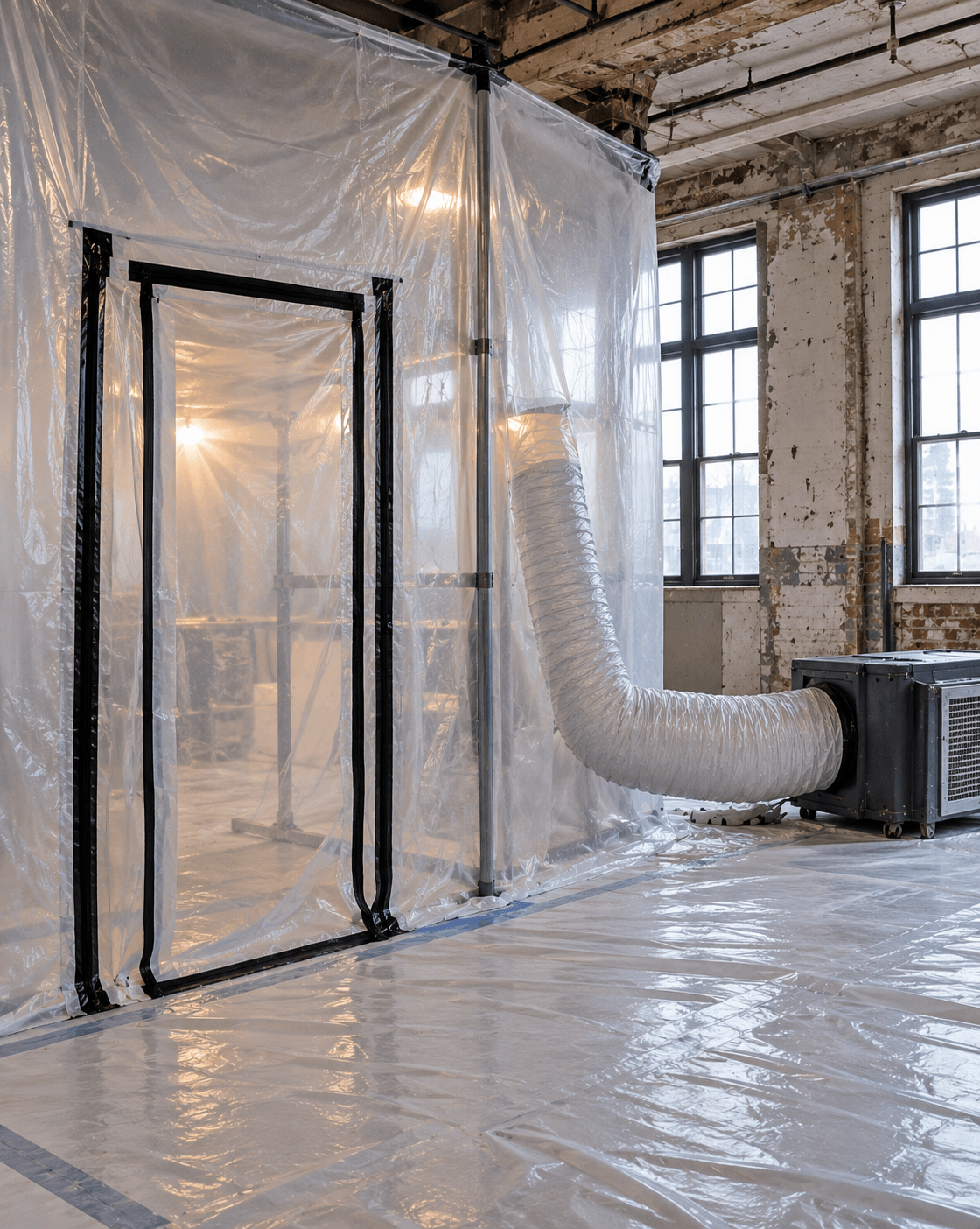
Ohio also requires anyone performing asbestos hazard abatement to be licensed or certified, with licenses issued by the director of environmental protection under Ohio Revised Code Chapter 3710. Bella does not perform asbestos abatement itself. It coordinates a licensed abatement contractor and the notification sequence as part of managing the job, and Bella’s own crews take over the general demolition once abatement is cleared. The common abatement approaches are covered in Bella’s overview of asbestos control methods.
Because the survey, notification, and abatement must happen in that order, they set the earliest realistic demolition start date. Bella builds that sequence into the schedule at the estimate stage rather than discovering it after the contract is signed.
Public improvement projects in Ohio fall under the state’s Prevailing Wage Law, Ohio Revised Code Chapter 4115, which the Bureau of Wage and Hour Administration within the Ohio Department of Commerce enforces. For building work, Ohio Revised Code 4115.03 sets the trigger at a project cost of more than $250,000 for new construction, or more than $75,000 for reconstruction, alteration, repair, remodeling, or renovation. The law has statutory exemptions, including projects undertaken by, or under contract for, a school district board of education, and where federal funding comes with its own predetermined wages, such as under the Davis-Bacon Act, the federal rates apply instead.
For a Cleveland municipal building, public authority project, or other public improvement, the qualification that matters is a contractor that already runs certified payroll. Bella produces certified payroll and has delivered work under Davis-Bacon Act requirements and Project Labor Agreements, including union and federally funded construction.
Public wage work adds administration a private job does not have: every worker classified to the correct trade rate, certified payroll submitted for the project, and records kept for review. Owners reduce that risk by choosing a contractor that already does it routinely.
Commercial projects often begin with removal: a tenant space stripped for a new layout, a floor plate opened up, or a vacant structure cleared so the site can be redeveloped. When demolition and construction sit with two different contractors, the handoff between them is where schedule and liability get argued over.
Bella self-performs demolition, so both halves run under one contract, one schedule, and one insurer. Bella’s demolition service in Cleveland covers structural, selective, interior, and emergency work, from interior strip-outs on a single floor to the full commercial demolition capability larger structures need, and the same project lead then carries the rebuild through final inspection.
When an emergency makes the first step urgent, such as fire or flood damage that leaves a structure unsafe, Bella’s emergency demolition response is available 24/7.
Bella Contracting Services is fully insured. Before contract signing, Bella provides certificates of insurance that name the owner or lender as additional insured. Ben Raabe, Bella’s chief executive, is a licensed contractor with more than 25 years of experience.
Bella’s licenses and registrations sit in the other jurisdictions where it works: New York General Contractor License 624832, which carries no height restriction and covers demolition, concrete, and general construction; New Jersey Home Improvement Contractor registration 13VH08295100; New Jersey Public Works Contractor Registration 723137; and Connecticut Major Contractor registration. None of them authorizes work in Cleveland, where the city’s own registration governs. What they show a Cleveland owner is a contractor already vetted in jurisdictions that regulate contractors.
Bella takes general contracting and commercial construction work throughout the City of Cleveland and Cuyahoga County, including Westlake, Rocky River, Parma, Strongsville, and Brecksville, communities where Bella already serves owners on demolition work.
Project scale matters more than location. Bella is built for commercial, industrial, institutional, and multi-unit work. It also accepts select residential projects case by case through a dedicated manager, but does not take small residential remodels.
Beyond Cuyahoga County, Bella handles demolition projects across Ohio, including Columbus and Cincinnati, and general contracting in New Jersey, New York, Connecticut, and Pittsburgh. Bella responds to project inquiries within one business day.
Ohio does not issue a state general contractor license. The Ohio Construction Industry Licensing Board licenses only five trades: heating, ventilating, and air conditioning, refrigeration, electrical, plumbing, and hydronics. The City of Cleveland regulates general contractors directly. Under Cleveland Codified Ordinances Section 3107.02, a contractor may not perform general contracting or demolition in the city without a current Certificate of Registration or Limited Certificate of Registration for that type of work, and building permits are issued only to registered contractors or exempt homeowners. Owners should ask for that registration along with current insurance certificates issued by the insurer.
Commercial construction in Cleveland is governed by the Ohio Building Code, Ohio Administrative Code Chapter 4101:1, which the Ohio Board of Building Standards adopts and which incorporates the 2021 International Building Code with Ohio modifications. Building permits are issued by the Division of Construction Permitting in the City of Cleveland Department of Building and Housing, and applications are filed through the city’s online Permit Portal, the only format the city has accepted since April 13, 2026. Bella Contracting Services prepares and files the permit application as part of its general contracting scope.
Generally yes. Ohio’s Prevailing Wage Law, Ohio Revised Code Chapter 4115, enforced by the Ohio Department of Commerce’s Bureau of Wage and Hour Administration, covers public building projects costing more than $250,000 for new construction or more than $75,000 for renovation and repair. School district projects are exempt, and federally funded work with its own predetermined wages, such as Davis-Bacon Act rates, follows the federal rules instead. Bella Contracting Services produces certified payroll and has delivered projects under Davis-Bacon Act requirements, prevailing wage rules, and Project Labor Agreements, including union and federally funded construction, which makes Bella a practical fit for Cleveland public works bid lists.
A general contractor holds the prime contract, hires and pays the subcontractors, and carries responsibility for delivering the finished building at the contract price and schedule. A construction manager typically advises the owner for a fee while the trade contracts stay in the owner’s name, which leaves more of the coordination risk with the owner. Bella Contracting Services works as a general contractor on Cleveland commercial projects. Bella signs the prime contract, its own project leads run the schedule, and it self-performs the demolition and structural scope rather than brokering it to another firm.
Bella Contracting Services focuses on commercial, industrial, institutional, and multi-unit construction in Cleveland, and its general contracting service is built around those projects. Bella also accepts select residential projects on a case-by-case basis, handled by a dedicated manager, but does not take small residential remodels. Property owners with a residential project can describe the scope through the estimate form on this page so Bella can confirm whether the project is a fit.
Bella Contracting Services prices each project after reviewing its scope. The most useful starting details are the property address, the building type and approximate square footage, whether the space stays occupied during the work, whether demolition is part of the scope, and whether any public funding is involved, since public funding can bring prevailing wage requirements. Bella typically responds to project inquiries within one business day. To start, call (855) 368-3366 or use the GET A FREE ESTIMATE button on this page to request a free estimate.
Still Have Questions?
Our team is here to answer all your questions and provide expert guidance for your project. Let’s talk!